By Jimi White
October 3, 2026
A Business Guide to Managing Building Security, Lock Rekeying, Restricted Keys, and Electronic Credentials During Employee Offboarding
By Jimi White, Fourth-Generation Owner & Security Expert – M. Spinello & Son Locksmiths Safe & Security Experts
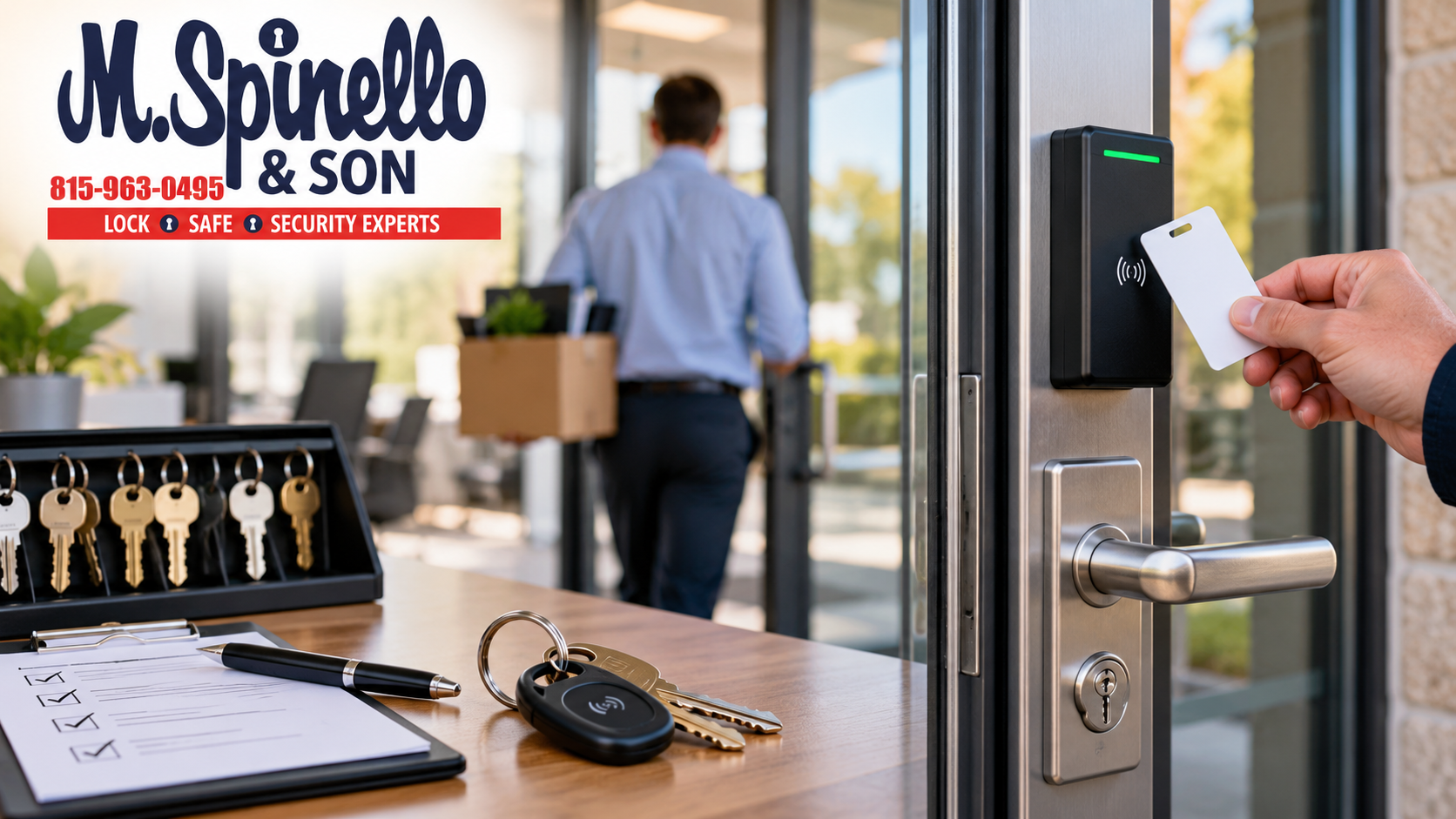
When an employee resigns, retires, is terminated, or unexpectedly leaves a company, most organizations immediately audit digital assets: computer passwords, email accounts, company phones, credit cards, and remote VPNs. However, physical building security is frequently overlooked.
Returning a physical key does not guarantee that duplicates don't exist. Deactivating a key fob does not prevent entry if the former employee possesses a mechanical override key. Changing a keypad code or computer password won't stop someone from entering through a propped interior door or using an uncollected master key.
For businesses, schools, churches, healthcare facilities, industrial plants, and municipalities across Northern Illinois, an employee departure should trigger a comprehensive physical access review.
At M. Spinello & Son Locksmiths Safe & Security Experts, we evaluate both mechanical hardware and electronic access control to ensure former staff can no longer enter your facility while keeping access seamless for remaining employees.
Audit Every Physical and Digital Access Point
Before changing locks or deleting credentials, perform a complete inventory of every door, gate, and application the departing employee could access.
Access Points to Evaluate:
- Mechanical Hardware: Exterior doors, interior offices, master keys, restricted keys, storage areas, and vehicle gates.
- Sensitive Interior Rooms: IT/server rooms, accounting offices, medication storage, tool rooms, file rooms, and warehouse cages.
- Electronic Credentials: Key fobs, access cards, mobile credentials, and keypad PIN codes.
- Digital & Remote Software: Remote access-control software, video surveillance apps, and video intercom release apps.
Longtime managers, supervisors, and maintenance personnel often accumulate access across multiple departments over time. Simply collecting one key during an exit interview is rarely sufficient.
A Returned Key Is Not a Controlled Key
Assuming that receiving a key back resolves your security risk is one of the most common security mistakes businesses make.
If your facility uses standard, unrestricted commercial keys, employees can duplicate them at hardware stores or automated kiosks without owner authorization. A former employee can return their original key while retaining an unrecorded duplicate.
Key Returned ≠ Key Controlled
Unless your facility utilizes a restricted key system or electronic access control, receiving a key back does not guarantee your perimeter is secure. If you cannot verify key control, rekeying the affected cylinders is the safest option.
When Should a Business Rekey After an Employee Leaves?
Not every departure requires rekeying an entire building. The decision depends on risk level, key types, and departing circumstances.
Key Factors to Consider:
- Key Restrictions: Was the key a standard unrestricted key or a patent-protected restricted key?
- Scope of Access: Did the employee possess a single office key or a master key that opens dozens of doors?
- Departure Conditions: Was the termination contentious, or was it a routine resignation?
- Asset Sensitivity: Does the employee's former area hold high-value inventory, cash, confidential client records, or trade secrets?
M. Spinello & Son evaluates existing key structures on-site to determine which cylinders actually require changing, avoiding unnecessary expenses.
Eliminate Uncontrolled Duplication with Restricted Key Systems
For facilities with recurring employee turnover, repeatedly rekeying traditional locks becomes expensive and disruptive.
Restricted key systems solve this problem by utilizing patent-protected keyways. Key blanks are not available to the public or standard key cutters. Duplicate keys can only be cut by M. Spinello & Son with direct authorization from designated company managers.
Benefits of a Restricted Key System:
- Zero Unauthorized Duplicates: Employees cannot make duplicate keys on their own.
- Hierarchical Access Control: Assign keys based strictly on job responsibility (e.g., department level, maintenance level, executive master).
- Long-Term Cost Savings: Eliminates the need to rekey every time a key is returned upon employee exit.
Properly Manage Your Master Key Hierarchy
Master key systems offer operational convenience, but they carry significant security risks if managed improperly. Losing control of a high-level master key compromises every door in the building.
Best Practices for Master Key Control:
- Maintain detailed records of every issued master key, including recipient name and issue date.
- Limit master key issuance strictly to key executive and facility personnel.
- Keep sensitive areas (e.g., HR, IT server rooms, cash vaults) off the master key system ("off-master").
If your organization lacks a written record of who holds master keys, schedule a key system audit immediately.
Simplify Employee Offboarding with Cloud Access Control
Electronic access control provides the fastest, most reliable method for managing employee departures.
When an employee leaves, an administrator can log into a cloud dashboard and immediately revoke their key card, key fob, or mobile credential.
Instant Deactivation = No Rekeying Required
Key Advantages for High-Turnover Facilities:
- Immediate Credential Revocation: Deactivate credentials in real time from any computer or smartphone.
- Custom Access Schedules: Restrict entry based on shift times, weekend permissions, or specific doors.
- Detailed Audit Trails: Review historical time-stamped logs of every door entry attempt.
- Multi-Site Management: Administer multiple buildings or branches across Northern Illinois from a single dashboard.
Don't Forget the Mechanical Override Key
A frequent gap in commercial security occurs when electronic credentials are deleted, but mechanical override keys remain unmanaged.
If an employee's key fob is deactivated, but they retain a physical key that bypasses the electronic strike or lock, your facility remains vulnerable.
M. Spinello & Son evaluates both mechanical and electronic hardware simultaneously. When installing access control, we integrate restricted cylinders into the mechanical overrides to prevent unauthorized key duplication.
Eliminate Shared Keypad PIN Codes
Shared PIN codes create severe accountability gaps. When ten employees share one code and one person leaves, management faces a dilemma: leave the code unchanged (risking unauthorized entry) or change it and redistribute it to everyone else.
Recommended PIN Protocols:
- Assign Individual PINs: Use access control systems that assign unique PINs or dual-authentication (PIN + Card) per employee.
- Immediate Updates: If your facility uses standalone keypads with shared codes, update the keypad combination immediately upon an employee's departure.
Secure Interior Doors & High-Value Areas
Offboarding should extend beyond perimeter doors. Former employees frequently retain knowledge of or access to sensitive interior spaces.
Priority Interior Spaces to Review:
- Server rooms & IT closets
- Accounting & HR document storage
- Inventory cages & tool rooms
- Executive suites & cash-handling zones
Interior openings can be cost-effectively secured using restricted mechanical locks, standalone electronic keypads, or fully integrated cloud access control.
Revoke App Access & Remote Permissions
Modern security systems rely heavily on smartphone applications. When offboarded, former personnel must be removed from administrative and user roles in:
- Access control management portals
- Mobile unlocking and video intercom apps
- Cloud video surveillance viewing software
Removing physical fobs while leaving remote app permissions active creates a major back-door security vulnerability.
Check Door Hardware: Closing, Latching, and Monitoring
An access control system or rekeyed lock is completely useless if the physical door does not close and latch properly.
Common Door Alignment Issues:
- Failing Door Closers: The door slams or stops short of latching.
- Sagging Frames & Hinges: Continuous wear causes latch bolt binding on electric strikes.
- Interfering Weatherstripping: Prevents proper engagement.
- Propped Doors: Employees propping perimeter doors open for convenience.
M. Spinello & Son inspects the entire opening—including frame condition, hinges, door closers, panic hardware, and electric strikes. We can also install door-position contacts that trigger alert notifications if a critical door is left open beyond a specified time limit.
Employee Physical Security Offboarding Checklist
Incorporate this checklist into your standard HR offboarding workflow:
- [ ] Collect all assigned mechanical keys and audit against key records.
- [ ] Deactivate electronic cards, key fobs, and mobile credentials in the access control portal.
- [ ] Revoke user permissions from remote apps (intercoms, cameras, mobile access).
- [ ] Change shared keypad codes across affected interior and exterior doors.
- [ ] Determine if unreturned or unrestricted keys require lock rekeying.
- [ ] Confirm perimeter doors are closing and latching securely without mechanical binding.
- [ ] Audit recent credential event logs if the departure involved security concerns.
- [ ] Document all returned hardware and updated security actions.
Why Work with M. Spinello & Son?
Employee transitions can complicate physical security, but fixing it doesn't require juggling multiple contractors or overpaying for unnecessary equipment.
Fourth-generation owner Jimi White has over 45 years of hands-on expertise spanning mechanical locksmithing, door hardware, electronic access control, and video surveillance. We evaluate your entire opening to deliver practical, long-term security.
The Spinello Advantage:
- Trusted Since 1905: Serving Rockford and Northern Illinois for over 120 years.
- No Subcontractors: Our licensed, direct technicians handle locksmithing, door repairs, wiring, and programming.
- Over 500 Five-Star Google Reviews: Proven local reputation for responsiveness and quality.
- One Company, One Solution: Complete single-point accountability for doors, locks, and access control.
Schedule Your Commercial Key Control & Access Assessment
Whether you need to rekey an exterior entrance, transition to restricted keys, or implement cloud access control, M. Spinello & Son Locksmiths Safe & Security Experts is ready to assist.
- Showroom: 522 Chestnut St., Rockford, IL 61102
- Phone: (815) 963-0495
- Service Area: Rockford, Loves Park, Machesney Park, Belvidere, Roscoe, Rockton, Freeport, DeKalb, Winnebago County, Boone County, Northern Illinois, and Southern Wisconsin.